
What Were Those Sacrifices Offered by Lehi?
I have been asked before about the sacrifices made by Lehi while in the wilderness as recorded in 1 Nephi 2-7. While there are some things we do not know, there are many clues in the text to help us understand what is happening. This article by S. Kent Brown is helpful in our quest to further understand what it was Lehi was doing when he made certain sacrifices in the wilderness and why made them.
The opening chapters of the Book of Mormon mention sacrifices offered by Lehi. Some are called “burnt offerings,”others simply “offering” or “sacrifice.” By examining the sacrifices of ancient Israel noted in the Bible, we come to an understanding of Lehi’s sacrifices—their meaning and their purpose. In short, Lehi made offerings for the safe return of his sons and for purging serious sins.
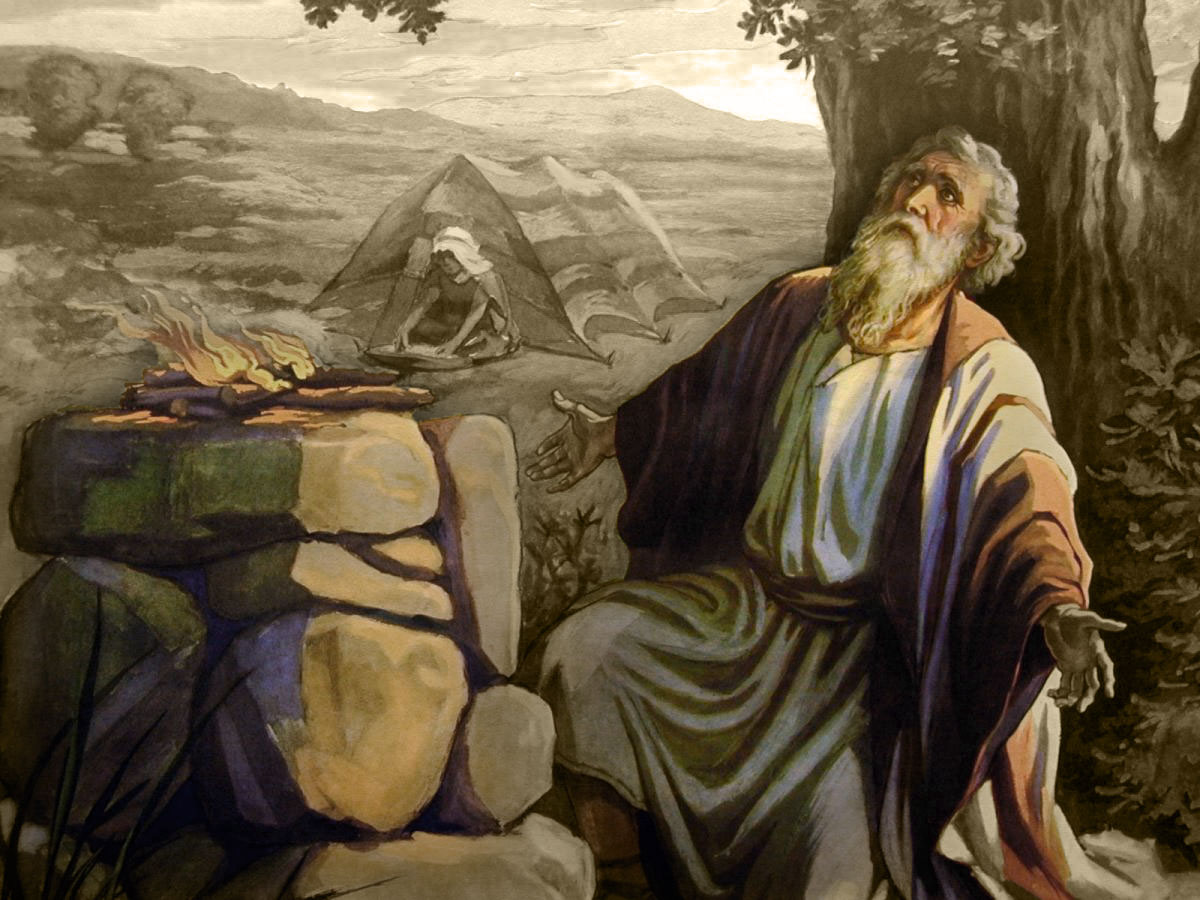 Twice in the desert, Lehi’s party offered “sacrifice and burnt offerings” while giving “thanks unto . . . God.” Each set of offerings came after the return of Lehi’s sons from extended trips back to Jerusalem. They first ventured forth to obtain the plates of brass (1 Ne. 5:9) and later to persuade, successfully, the family of Ishmael to join their modest-sized exodus to a new land of promise (7:22). But on a prior occasion, when Lehi’s family initially set up its base camp not far from the shore of the Red Sea (2:5–6), Lehi “built an altar of stones” and thereafter “made an offering . . . and gave thanks unto the Lord” (2:7) [1] In this case, Nephi mentions no burnt offerings. Why not? What was the difference?
The difference is the presence of sin, real or perceived. But the sin stands in relief only when we notice the common elements peeking out of all the accounts. In each of the three instances—the family’s move to the base camp, the return of the sons with the brass plates, and their later return with Ishmael’s family—the common factors are a safe journey and the subsequent giving of thanks. We then ask, How much do these observations tell us about the sacrifices? A lot.
Peace Offerings
For a safe journey, according to Psalm 107, a person was to “sacrifice the sacrifices of thanksgiving” (107:22) for safety in travel, whether through the desert or on water (107:4–6, 19–30). What were those “sacrifices of thanksgiving”? They consisted of peace offerings, known from Leviticus 3. In fact, the second common feature—the family giving thanks—secures the interpretation that these sacrifices were indeed peace offerings serving as thanksgivings to the Lord.
At this juncture it is important to note three characteristics of peace offerings. First, the Hebrew term which is translated “peace offering” in the King James translation properly means an offering for well-being, [2] thus its tie to safety in traveling. This observation leads to a second one, that the peace offering served many purposes, only one of which was thanksgiving. [3] Third, and not incidentally, in all of its forms this offering was an occasion for rejoicing, a happy state that Nephi highlights for us when recounting the mood of Lehi’s sacrifice after the sons returned with the brass plates: “Their joy was full” (1 Ne. 5:7). [4] This last observation tightens the knot on the conclusion that in every instance Lehi’s sacrifices consisted of a peace offering used for expressing thanksgiving.
Notably, peace offerings were “the most common type of sacrifice,” an offering accompanied by a “covenant meal” in which worshipers enjoyed “fellowship with one another and their God.” Truly such occasions were to be a time of rejoicing. [5] Furthermore, the sacrifice itself was to be an animal—either “male or female” in this case—from the flock or herd (Lev. 3:1, 6, 12), accompanied by unleavened baked goods (7:12–13). In this light, one has to assume either that among the “provisions” moved by Lehi’s family from Jerusalem were animals intended for sacrifice (1 Ne. 2:4) or, more probably, that Lehi’s baggage bore goods that the family could exchange with local people for sacrificial animals. [6] According to Leviticus, the resulting foods for the feast, including the sacrificed animal, were to be “eaten the same day that [they were] offered” so that nothing of the sacrifice remained to the following morning (Lev. 7:15) [7] Thus the banquet and celebrating would continue into the night.
Burnt Offerings
Thus far, we have established that the sacrifices made by Lehi were peace offerings, an observation made firm through details in the account, such as Lehi’s party giving thanks and taking the occasion for rejoicing. [8]Contributing also is the fact that under the Mosaic law it was customary that one offer a sacrifice when one safely completed a journey. [9] We now turn to the need for the burnt offerings.
Why, one may ask, did Lehi offer this other kind of sacrifice? In response we note that according to Leviticus 1 a burnt offering was made for atonement—and more specifically, purging—after one had committed sin. [10] “If any man of you bring . . . a burnt sacrifice . . . it shall be accepted for him to make atonement” (1:2–4). In the case of burnt offerings, the animals for sacrifice might come from a herd or flock, or they might be birds (1:3,10, 14). If the animals, only males in this instance, came from a herd or flock, then, as with the peace offerings, Lehi’s family would have either brought them from Jerusalem—unlikely in light of Nephi’s description of what they took from home (“provisions”)—or purchased them locally. If Lehi offered birds, he likely bought them from someone in the area of the base camp who raised domesticated fowl. [11]
The more important issue, of course, has to do with sin, real or suspected, and how one transferred it away. [12] For sacrifices offered at the temple in Jerusalem, the priests were under daily obligation to sacrifice burnt offerings on the chance that someone in ancient Israel had sinned. Naturally, the priests could not realistically check in every corner of the land for sinning, but they could safely assume that every day someone had committed some sin, thus justifying the burnt offerings. Hence, the offerings were intended to cover all possible bases, whether the sin was known or not. [13]
In the case of Lehi’s burnt offerings, sin stood close by. In a couple of instances, of course, one might question whether family members had really committed sin. But one must remember that Lehi was proceeding as if he were a priest offering sacrifices at the temple just in case.
Lehi’s Offerings
Let us take up the two instances wherein Lehi offered burnt offerings, but in reverse order. The second time that Lehi sacrificed burnt offerings came after the return of his sons with the family of Ishmael (1 Ne. 7:3–22). Where was the sin? It springs quickly into view. The brothers’ long journey to Jerusalem seems to have gone well, since Nephi does not comment on it. But during the return trip to the camp, a quarrel erupted when the older brothers, along with members of Ishmael’s family, announced that they had decided to return to the city instead of continuing to the camp. Nephi, not shy in expressing his feelings about his brothers’ “rebellion,” became embroiled in a heated exchange of words that eventually provoked his angry brothers into tying him up “with cords” so “that they might leave [him] in the wilderness to be devoured by wild beasts” (7:7, 16). Only the miraculous intervention of the Lord and the poignant pleading of certain women in the company softened the hearts of the brothers so that “they did cease striving to take away [Nephi’s] life” and sought his forgiveness (7:17–20). Even though Nephi “did frankly forgive them all that they had done” (7:21), there still remained the necessity to purge their sin from themselves. After the brothers sought Nephi’s forgiveness, Nephi then records that “I did exhort them that they would pray unto the Lord their God for forgiveness” (7:21, emphasis added). At the very least, Nephi saw sin. As a result, after the party reached the camp, Lehi found it necessary to “offer . . . burnt offerings” to the Lord (7:22). There was no reason to take a chance.
An earlier scene recounts the trip of Lehi’s sons back to Jerusalem to obtain the plates of brass. In this case, one does not need to look far to find sin. It poked its head up even before the sons left camp, as soon as Lehi asked them to bring the brass plates from Laban’s custody to himself. Disappointedly, Lehi confided to Nephi that “thy brothers murmur, saying it is a hard thing which I have required of them; but . . . it is a commandment of the Lord” (3:5). Lehi’s choice of the verb to murmur clearly ties the attitude of his older sons to that of the resisting Israelites during the Exodus from Egypt, [14] a stance that Nephi later characterized as “revil[ing] against Moses and against the true and living God”(17:30). Such complaining on its own constituted mild rebellion. But there is more.
After arriving in the city, Nephi and his three brothers made two unsuccessful attempts to acquire the brass plates, once by persuasion and the other time by an offer to purchase them, the latter occasion presenting to Laban an opportunity to falsely accuse the brothers of theft. As a result, the two older brothers, Laman and Lemuel, decided to take matters into their own hands and began to “smite [their younger brothers] even with a rod.” This action was cut short by the unexpected intervention of “an angel of the Lord” who scolded the two oldest brothers for their conduct (3:28–29), emphasizing the fact that their behavior defied the Lord’s purposes. Even then, the brothers continued “to murmur” (3:31; 4:4).
In addition to the complaints and ill-behavior of the older brothers, one discovers that Lehi’s wife, Sariah, had complained at length to her husband during the month–long absence of her sons. [15] She feared that her sons must have “perished in the wilderness” and that because Lehi was “a visionary man,” an expression that must have carried pejorative meaning, [16] “we [shall] perish in the wilderness” far “from the land of our inheritance” (5:2). Of course, when her sons returned to camp, she immediately changed her tune, rejoicing and becoming “exceedingly glad” (5:1). But what is more important, she thereafter affirmed her testimony in the divine guidance received by her husband: “Now I know of a surety that the Lord hath commanded my husband to flee into the wilderness; yea, and 1 also know of a surety that the Lord hath protected my sons” (5:8). Even so, her sin had to be purged both from herself and from the camp.
While these occurrences may seem mild, involving complaints and a family scuffle, another one was not, for it involved what some might have considered a homicide. Nephi killed Laban (4:4–18), creating a need for sacrifice. To be sure, Nephi assures us that he had been impelled to this deed by the promptings of the Spirit—three times in fact, the last coming in an audible voice [17]—and he had stubbornly resisted. After all, he had just been admiring the workmanship of Laban’s sword in the moonlight, [18] as the latter lay drunk in the street, when the Spirit interrupted his thoughts with the horrifying impression that Nephi use the sword on Laban. Struggle as Nephi might, he could not shake the persisting feelings, growing stronger by the minute, that he take Laban’s life.
Although the Lord clearly placed Laban among “the wicked” (4:13) and although Nephi knew Laban’s failings because “he had sought to take away [Nephi’s] life” and “also had taken away our property” (4:11), Nephi “shrunk and would that I might not slay” Laban (4:10). In the end, however, Nephi “did obey the voice of the Spirit, and . . . I smote off [Laban’s] head with his own sword” (4:18), thus creating the deepest need for Lehi to “offer . . . burnt offerings unto the Lord” to purge any vestiges of uncleanness that might have clung to Nephi (5:9). [19]
Conclusion
The three recorded occasions of Lehi offering sacrifices, when measured against sacrificial law in the Bible, become immediately understandable in light of the family’s situation. When Lehi “made an offering unto the Lord, and gave thanks” (1 Ne. 2:7; also 5:9; 7:22), he was sacrificing a peace offering which served as a thanksgiving for safety in travel, whether for oneself or for others. In each instance, members of the family had safely completed a long journey. [20] When he offered “burnt offerings unto the Lord” (5:9; also 7:22), Lehi was bringing to the altar sacrifices that would atone for sin, sin that would stain the camp and those within it. And in each case, one can readily detect sin in the prior behavior of family members, whether it took the form of complaining, family jousts, or the taking of human life. Here, Lehi sought to free his extended family from the taint of unworthiness so that he and they would be able to carry out the purposes of the Lord.
Notes
[1]The phrase “altar of stones” derives from Mosaic Law (see Ex. 20:24–25; Deut. 27:5–7). On the character of Lehi’s altar, Hugh Nibley has pointed out—rightly in my view—that in accord with the law of Moses, it must have been of unhewn field stones; Lehi in the Desert, The World of the Jaredites, There Were Jaredites (Salt Lake City: Deseret Book and F.A.R.M.S., 1988), 62–63.
[2] Hebrew zebah selamim, “sacrifice of well-being.” Jacob Milgrom, Leviticus 1–16, Anchor Bible 3 (New York: Doubleday, 1991), 204, 217.
[3] The biblical forms include the thanksgiving offering (e.g., Lev. 22:29), the freewill offering (e.g., Num. 15:3), and the sacrifice for a vow (e.g., Prov. 7:14); see Milgrom, Leviticus 1–16, 218–19. In a much later era, without acknowledging other purposes, Josephus would call these simply “thank offerings” {Antiquities 3.9.2).
[4] See Deut. 27:7; also Milgrom, Leviticus 1–16, 218.
[5] Nathaniel Micklem, The Book of Leviticus, The Interpreter’s Bible, ed. G. A. Buttrick (New York: Abingdon, 1953), 2:21–22.
[6] That there must have been many people living in the area of Lehi’s base camp cannot be doubted, since the incense trail passed through the region, and local people were needed to service the caravans at their stops. For a review of the civilizations that existed in Arabia during the mid-first millennium b.c., see Gus W. van Beek, “South Arabian History and Archaeology,” in The Bible and the Ancient Near East, ed. G. Ernest Wright (New York: Doubleday, 1965), 300–26.
[7] See Milgrom, Leviticus 1–16, 219.
[8] The burnt offering, under certain circumstances, could also bring a time for rejoicing; see Milgrom, Leviticus 1–16,175; cf. 219, 758.
[9] Nibley, in Lehi in the Desert, 62–63, has pointed out that Arabs also perpetuated such a custom.
[10] The Hebrew term is ‘ola, the oldest known propitiatory offering. See Milgrom, Leviticus 1–16, 175–77, 267–68, 858.
[11] One issue is whether a person could offer a sacrifice of birds snared in the wild. The answer is yes. While the law specifies “turtledoves, or . . . young pigeons” (Lev. 1:14), which were the birds most frequently domesticated, one could presumably also offer wild ones. See Milgrom, Leviticus 1–16, 168–69.
[12] In the ceremony of the burnt offering, before slaughtering the sacrificial animal, the petitioner placed a “hand upon the head of the burnt offering” (Lev. 1:4), thus transferring guilt to the animal. See Milgrom, Leviticus 1–16, 150–53.
[13] See Ex. 29:38–46; Lev. 1:7; 6:12–13; also Milgrom, Leviticus 1–16, 146—”it is the first sacrifice [and last] each day”; see also 157, 387.
[14] See Terrence L. Szink, “Nephi and the Exodus,” in Rediscovering the Book of Mormon, ed. John L. Sorenson and Melvin J. Thorne (Salt Lake City: Deseret Book and F.A.R.M.S., 1991), 38–51.
[15] The length of a one-way trip to Jerusalem from the camp, which lay sixty or so miles south of modern Aqaba, a journey of “three days” from the northeast tip of the Red Sea (1 Ne. 2:6), would have been almost 250 miles, a distance that would require nine or ten days for young men to walk. See D. Kelly Ogden’s study, the last of many to calculate this distance, “Answering the Lord’s Call,” in Studies in Scripture, Vol. 7:1 Nephi to Alma 29, ed. Kent P. Jackson (Salt Lake City: Deseret Book, 1987), 17–33. For observations on the possible location of the camp, see Lynn M. and Hope A. Hilton, “In Search of Lehi’s Trail, Part 2: The Journey,” Ensign, October 1976, 43–45. The outlook of the Hiltons that matches a journey of “three days” beyond Aqaba is more compelling than that of Paul Hedengren, The Land of Lehi (Provo, Utah: Bradford & Wilson, 1995), 3–4, even though Hedengren has identified a year-round source of water just a few miles south of Aqaba, which he identifies as the river Laman. Lehi and his family could have reached this water source after only one day’s trek.
[16] This sense must be correct, because Lehi felt the need to turn Sariah’s phrase into a more positive view: “I know that I am a visionary man; for if I had not seen the things of God in a vision I should not have known the goodness of God, but had tarried at Jerusalem, and had perished with my brethren” (1 Ne. 5:4).
[17] Cf. “When I, Nephi, had heard these words” (1 Ne. 4:14, emphasis added).
[18] Nephi had gone into the city “by night,” and thus there must have been moonlight which allowed him to examine the sword (1 Ne. 4:5, 9).
[19] There are several treatments of Nephi’s defense of his actions with Laban. See, for example, Noel B. Reynolds, “The Political Dimension of Nephi’s Small Plates,” BYU Studies 27, no. 4 (fall 1987): 15–37, especially 24; Eugene England, “Why Nephi Killed Laban: Reflections on the Truth of the Book of Mormon,” Dialogue: A Journal of Mormon Thought 22 (fall 1989): 32–51, especially 40–45; and John W. Welch, “Legal Perspectives on the Slaying of Laban,” Journal of Book of Mormon Studies 1 (fall 1992): 119–41. Even though laws existed that would protect Nephi until he received a fair hearing, as Reynolds points out, the killing of Laban potentially brought sin within Lehi’s camp. In addition, because Laban’s death allowed the sons to obtain the brass plates, this incident must have lived on in memory and stood behind the later Lamanite claim that Nephi had “robbed them” of the plates (Mosiah 10:16).
[20] It is possible that without mentioning sacrifice directly, Nephi intended his readers to understand that there were other occasions when Lehi’sparty would have sacrificed peace offerings in order to conform to Mosaic requirements. Nephi repeats key words and phrases—already used in the three known instances—in connection with the family’s comings and goings as well as preparations for continuing the journey. See 1 Ne. 16:32 (“did give thanks”), 17:6 (“exceedingly rejoiced”), 18:1 (“worship the Lord”), 18:4 (“humble themselves again before the Lord”), and 18:23 (“We did arrive”), coupled with the presence of clean animals in the promised land that could be sacrificed (18:25). The phrase “before the Lord” may also point in some of these instances to worship at an altar (16:32; 18:4).